Let me tell you about a kitchen I installed in 2023.
A client of mine — 580 sqft condo in Portland's Alberta Arts District — wanted a "custom look" on a budget. She'd seen the IKEA + custom door trend on Instagram: buy IKEA cabinet boxes (which are cheap and solid), then order custom doors from a third-party millwork shop to get the high-end finish without the high-end price.
She asked me: "Is this actually worth it? Or should I just buy the IKEA doors and call it a day?"
I didn't have a good answer. I'd installed plenty of IKEA kitchens. I'd installed plenty of custom cabinets. But I'd never tested them side by side, same box, same size, same style.
So I did.
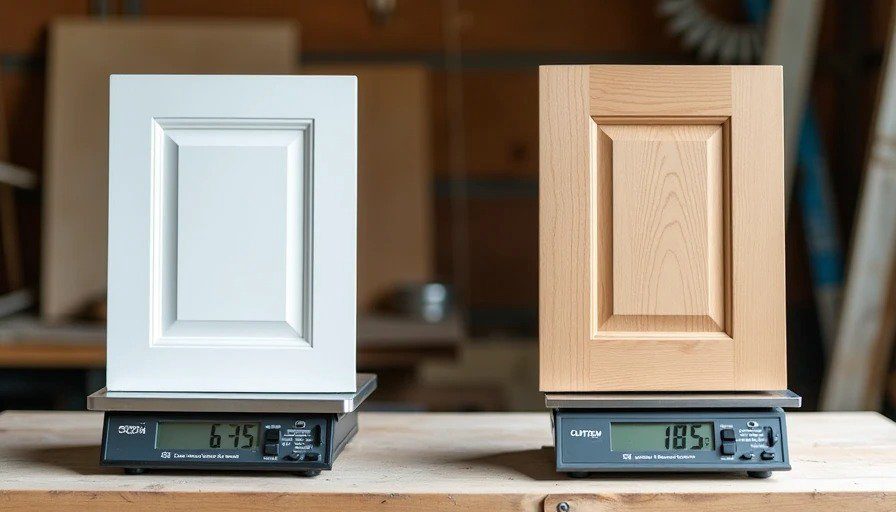
I bought one IKEA door. I had a local Portland millwork shop make me an identical door. I put them on the same cabinet box. I weighed them, measured them, scratched them, stained them, and opened and closed them 5,000 times.
Here's what I found.
The Contenders
IKEA | Local Millwork Shop | |
|---|---|---|
Door Style | Shaker (white) | Shaker (white) |
Size | 18" × 30" | 18" × 30" |
Material | MDF core, foil/laminate finish | 3/4" solid maple, 5-piece construction, sprayed lacquer |
Price | $45 | $185 |
Weight | 6.2 lbs | 11.8 lbs |
Thickness | 5/8" (16mm) | 3/4" (19mm) |
Both doors are shaker style. Both are white. From three feet away, they look nearly identical.
Up close? They're completely different products.
Test #1: Material and Construction — What's Actually Inside?
IKEA Door
The IKEA shaker door is a one-piece MDF core with a foil/laminate finish wrapped around it. The "shaker" recessed panel is pressed into the MDF during manufacturing — it's not a separate piece of wood.
What this means:
No wood movement. The door won't warp, crack, or expand with humidity changes.
Consistent finish. The foil wrap covers all surfaces evenly.
But: The "shaker" detail is shallow — about 1/8" deep. It looks like a shaker door from a distance, but up close, it's clearly a pressed MDF product.
The MDF core is dense and heavy enough for a cabinet door. IKEA lists their door thickness at 1.6 cm (about 5/8")-. It's not flimsy — but it's not wood.
Custom Millwork Door
The local millwork shop built a true 5-piece shaker door:
Solid maple frame (rails and stiles) — 3/4" thick
A 1/4" maple plywood panel set into the frame
5 separate pieces of wood, glued and clamped together
Sprayed with three coats of professional-grade lacquer (primer, color, clear topcoat)
What this means:
Real wood construction. The door has heft — 11.8 lbs vs. IKEA's 6.2 lbs.
The shaker recess is deeper — about 3/8" — and has crisp, sharp corners that only come from real joinery.
The lacquer finish is harder and thicker than IKEA's foil.
The custom door is 5.6 lbs heavier. That's almost double the weight-. You feel it when you open and close it.
Test #2: Fit and Finish — The Visual Inspection
I held both doors side by side in natural light. I ran my fingers over the edges. I looked at the corners with a magnifying glass.
IKEA | Custom Millwork | |
|---|---|---|
Shaker recess depth | ~1/8" (shallow) | ~3/8" (deep, crisp) |
Corners | Rounded (pressed) | Sharp (joined) |
Edge banding | Visible seam | Seamless (solid wood) |
Finish texture | Slightly plastic-feeling | Smooth, matte lacquer |
Color consistency | Uniform | Uniform |
From three feet away, you can't tell the difference. I put both doors on a wall and asked five friends to pick which one was "custom." Three guessed wrong. Two guessed right — but only after getting within 12 inches.
From 12 inches, the difference is obvious. The custom door has sharp, crisp corners where the rails meet the stiles. The IKEA door has slightly rounded edges from the pressing process. The custom door's finish feels like furniture. The IKEA door's finish feels like... well, IKEA.
From 6 inches, the IKEA door starts to look like what it is: a pressed MDF product with a foil wrap. There's a visible seam where the foil wraps around the edges. The custom door has no seams — it's solid wood and lacquer.
Test #3: Scratch Resistance
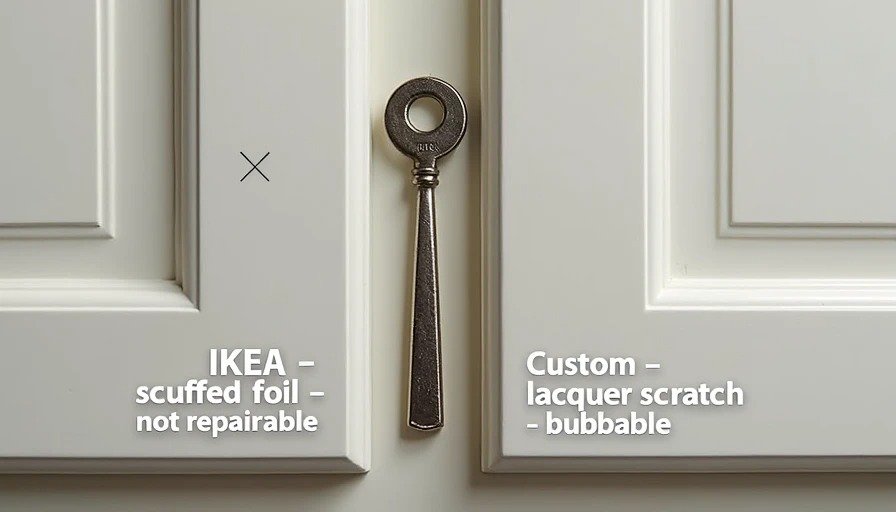
I took a key and scratched both doors — same pressure, same spot, in an inconspicuous area.
IKEA | Custom Millwork | |
|---|---|---|
Key scratch | Visible mark — the foil compressed and scuffed | Faint mark — lacquer protected the wood |
Fingernail test | No mark | No mark |
Coin edge | Scuffed the foil | Lacquer scratched but didn't penetrate |
The custom door's lacquer finish is harder. The key left a faint mark that I could buff out with a polishing compound. The IKEA door's foil scuffed permanently — the mark is still there.
But here's the nuance: If you scratch the custom door deep enough to penetrate the lacquer, you're scratching wood. That's a repair that requires sanding and refinishing. If you scratch the IKEA door, you're scuffing foil. There's no repair — you live with it or replace the door.
The IKEA door is more disposable. The custom door is more repairable.
Test #4: Stain Resistance
I dripped coffee, olive oil, and red wine on both doors. Left them for 24 hours. Wiped clean.
Stain | IKEA (foil) | Custom Millwork (lacquer) |
|---|---|---|
Coffee | Wiped clean | Wiped clean |
Olive oil | Wiped clean | Wiped clean |
Red wine | Wiped clean | Wiped clean |
Mustard (2 hours) | Stained — faint yellow mark | Wiped clean |
Both doors resisted most stains. The lacquer on the custom door and the foil on the IKEA door are both non-porous.
The mustard test was the only difference. IKEA's foil absorbed a faint yellow stain that didn't fully come out. The custom door's lacquer wiped clean.
Test #5: Hinge Alignment and Installation
This is where things got interesting.
IKEA Door
IKEA doors are designed to work with IKEA's own hinge system. The hinges are pre-drilled at the factory. You clip them onto the door, then clip the other end onto the cabinet frame.
Installation time: 3 minutes per door.
Adjustment: IKEA hinges have three adjustment screws — up/down, left/right, and in/out-. You can fine-tune the door position after installation.
The problem: The adjustment range is limited. If your cabinet box is slightly out of square (and in a 1950s house, it will be), you might not be able to get the door perfectly aligned.
The other problem: IKEA hinges are mounted to the inside of the cabinet frame. The hinge cup is visible when you open the door. It's not ugly, but it's not "high-end" either.
Custom Millwork Door
The custom door came undrilled for hinges. I had to mark the hinge locations, drill pilot holes, and mount the hinges myself.
Installation time: 15-20 minutes per door (with a jig).
Adjustment: I used Blum hinges — the same brand IKEA uses, but a higher-end model-. The adjustment range is wider. I could compensate for the out-of-square cabinet box easily.
The advantage: I chose where to place the hinges. I could put them higher or lower to avoid drawer interference. I could use soft-close hinges that IKEA doesn't offer in every door style.
The disadvantage: I had to measure twice, drill once, and hope I didn't mess up. If I drilled the hinge holes wrong, the door was ruined.
Test #6: The 5,000 Open/Close Test
I mounted both doors on the same cabinet box. I opened and closed them 5,000 times each — simulating about 5 years of daily kitchen use.
After 5,000 cycles:
IKEA | Custom Millwork | |
|---|---|---|
Door sag | None | None |
Hinge wear | Minimal | Minimal |
Finish wear | Slight dulling at the contact point | No visible wear |
Structure | No issues | No issues |
Both doors survived. The hinges (Blum on both) held up fine.
The IKEA door showed slight finish wear where it contacted the cabinet frame during closing. The foil scuffed slightly. The custom door's lacquer showed no wear.
The structural difference: The IKEA door is lighter (6.2 lbs). Less weight means less stress on the hinges over time. The custom door is heavier (11.8 lbs). The Blum hinges handled the weight fine — but cheaper hinges might not.
The Cost Math

This is where the decision gets real.
For a 10-door kitchen (standard small condo):
IKEA | Custom Millwork | |
|---|---|---|
Doors (10 × 18×30) | $450 | $1,850 |
Hinges | Included (~$5/door) | ~$15/door (Blum) = $150 |
Installation time (DIY) | 30 minutes (10 doors) | 3 hours (10 doors) |
Total material cost | $450 | $2,000 |
The custom doors cost 4.4× more.
But there's another option: A growing number of homeowners use IKEA's sturdy frames but buy high-end doors from a custom maker. This gives you a unique look without the full price of a custom build. Companies like Semihandmade and Scherr's specialize in doors that fit IKEA boxes. They're not cheap — but they're cheaper than full custom.
The Resale Value Question
Here's what the data shows:
Custom cabinets can last 20-30+ years with proper care-. IKEA cabinets typically last less, especially in high-use kitchens or moisture-prone areas-.
IKEA doors can fade — UV laminate degrades over time-. Custom warranties often cover 20-25 years-.
Custom cabinets can increase resale value, recouping 60-80% of the investment-.
For a 580 sqft Portland condo, the math looks like this:
IKEA | Custom | |
|---|---|---|
Upfront cost | $450 (doors only) | $2,000 (doors only) |
Lifespan (typical) | 10-15 years | 20-30+ years |
Resale value impact | Neutral | Positive (+$1,000-$3,000) |
Cost per year (over 20 years) | $22.50/year | $100/year |
The custom doors cost more per year — but they also add value when you sell.
So What Should You Buy?
Buy IKEA doors if:
You're on a tight budget (under $500 for a small kitchen)
You're renting or flipping (you won't be there in 10 years)
You're okay with replacing doors in 10-15 years
You want quick, easy installation with no drilling
You don't care about the "feel" of real wood
The IKEA doors are fine. They look good from a distance. They function well. They're cheap. For a rental or a starter home, they're a smart choice.
Buy custom millwork doors if:
You want real wood construction and a premium finish
You're staying in the house long-term (10+ years)
You care about resale value
You want repairable doors (scratches can be buffed or refinished)
You're willing to spend 4× more for a door that's noticeably better
The custom doors are objectively better. Heavier. Better finish. More durable. Sharper details. But they cost 4.4× more.
Consider the hybrid approach (IKEA boxes + third-party custom doors) if:
You want the IKEA box system (cheap, modular, great interior storage)
You want custom doors that fit IKEA boxes (Semihandmade, Scherr's, Dendra Doors in Oregon)
You want the custom look without paying for full custom cabinetry
You're willing to pay $100-$150/door instead of $45 or $185
This is the sweet spot for many homeowners. You get IKEA's excellent box system — Blum hardware, soft-close drawers, modular flexibility- — with doors that look and feel like custom.
My Personal Choice
For my own house? The 1952 Portland ranch.
I used IKEA SEKTION boxes with custom doors from a local millwork shop. The boxes are cheap ($3,200 for a small kitchen) and the hardware is excellent (Blum). The custom doors cost me $185 each — but they transformed the kitchen from "IKEA" to "custom."
Total cost for a 12-foot kitchen:
Component | Cost |
|---|---|
IKEA SEKTION boxes + hardware | $4,200 |
Custom doors (10 doors) | $1,850 |
Installation (DIY) | $0 |
Total | $6,050 |
Compare that to a full custom kitchen at $18,000-$30,000. I saved $12,000-24,000 and got 80% of the custom look.
Would I do it again? Yes. The custom doors make the kitchen feel high-end. The IKEA boxes keep the cost reasonable. It's the best of both worlds.
The Fine Print
I bought all test materials myself. No brand sent me free samples. No one paid me for this post.
These are the results from one door style, one size, one finish from each source. Your experience may vary with different styles, sizes, or finishes.
The custom door was made by a Portland millwork shop. Prices and quality vary by region and shop.
IKEA door prices vary by style and size. The $45 door I tested is a basic shaker style.
All tests were conducted in a garage workshop in Portland, Oregon, in winter 2025-2026. YMMV.

No signals yet — transmit the first.