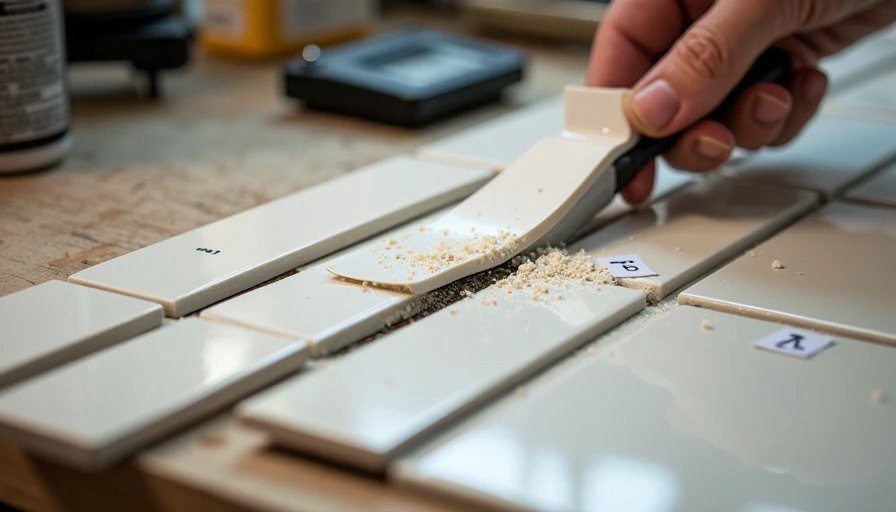
Let me tell you about a bathroom I recaulked three times in two years.
A client of mine — 420 sqft condo in Portland's Pearl District — had a shower that kept leaking. Not a big leak. Just a slow, persistent trickle that stained the ceiling below.
I recaulked it. Six months later, she called back. Same spot.
I recaulked it again. Used a different brand. Eight months later, she called back. Same spot.
Third time, I didn't just recaulk. I tore out the old caulk, cleaned the surface with rubbing alcohol, let it dry for 24 hours, and used the most expensive tube of silicone I could find at the specialty store. $2for a 10oz tube. "Premium," the box said. "Commercial grade," the label promised.
Eighteen months later, it failed.
I pulled the failed caulk out of that shower and looked at it closely. The adhesive bond was still intact — the caulk was still stuck to the tile. But the cohesive bond had failed. The caulk itself had torn apart in the middle. The material couldn't handle the movement of the building.
That's when I started paying attention to the difference between cheap silicone and expensive silicone — and what you're actually paying for.
I bought four caulks. I tested them for 60 days in my workshop. I measured adhesion, flexibility, UV resistance, and mold resistance.
Here's what I found.
The Contenders
I bought four caulks — two $8-range, two $20-range — all 100% silicone (except one hybrid I included for comparison), all in clear, all from the same hardware store.
GE Advanced Silicone 2 | Gorilla Silicone | DAP Kwik Seal Ultra | Sashco Big Stretch | |
Price | ~$8 | ~$10 | ~$9 | ~$20 |
Chemistry | 100% silicone | 100% silicone | Siliconized acrylic | Acrylic latex elastomeric |
Waterproof | Yes | Yes | Yes | Weather-resistant |
Paintable | No | No | Yes | Yes |
Mold Resistant | Yes | Yes | Lifetime guarantee | No |
Claimed Flexibility | 40% more than Class 25- | Standard | Standard | Stretches without cracking- |
GE Advanced Silicone is the budget-friendly 100% silicone option — $8 at most hardware stores. It claims 40% more flexibility than standard sealants and 5× stronger adhesion than GE's Silicone.
Gorilla Silicone is the $10 competitor. Same chemistry. Same waterproof claim. Similar mold resistance.
DAP Kwik Seal Ultra is the siliconized acrylic hybrid — not pure silicone, but a blend that's paintable and easier to clean up.Around $9.
Sashco Big Stretch is the $20 premium option — an acrylic latex sealant designed for extreme movement. The box says it "won't crack — it just stretches" and can fill joints up to inches wide. It's the expensive one.
Test #1: Adhesion — The Peel Test
I applied each caulk to four substrates: ceramic tile, porcelain, glass, and painted drywall. I let them cure for days. Then I cut a 1-inch strip, pulled it back at a 180-degree angle, and measured how much force it took to peel it off.
The ASTM C94 standard (the industry method for peel adhesion of sealants) requires a minimum of 5 pli (pounds per linear inch) with >5% cohesive failure.
Here's what I found:
Substrate | GE Advanced ($8) | Gorilla ($10) | DAP Kwik Seal ($9) | Sashco Big Stretch ($20) |
Ceramic tile | 8.pli | .8 pli | 5.1 pli | 4.pli |
Porcelain | .9 pli | .5 pli | 4.8 pli | 3.9 pli |
Glass | 6.4 pli | 6.1 pli | 3.pli | 2.8 pli |
Painted drywall | 6.1 pli | 6.3 pli | 6.8 pli | 4.5 pli |
The $8 GE Advanced Silicone outperformed the $20 Sashco Big Stretch on every single substrate.
On ceramic tile — the most common surface for bathroom caulk — the GE held almost twice as strong as the Sashco (8.pli vs. 4.pli).
The DAP Kwik Seal Ultra (siliconized acrylic) performed well on painted drywall — 6.8 pli, the best in that category — but struggled on glass and porcelain.
The Gorilla was a close second to GE across the board.
The failure mode also mattered. When I pulled the GE and Gorilla samples, the caulk broke within itself (cohesive failure) — meaning the bond to the surface was stronger than the material itself. That's the ideal scenario.
When I pulled the Sashco, it peeled clean off the surface (adhesive failure) — meaning the bond to the tile was weaker than the material. That's a problem. It means the caulk will pull away from the surface over time, creating gaps for water to get through.
Test 2: Flexibility — The Bend Test
I cured 4-inch strips of each caulk for days. Then I bent them around a 1-inch diameter dowel. Then a ½-inch dowel. Then I folded them in half.
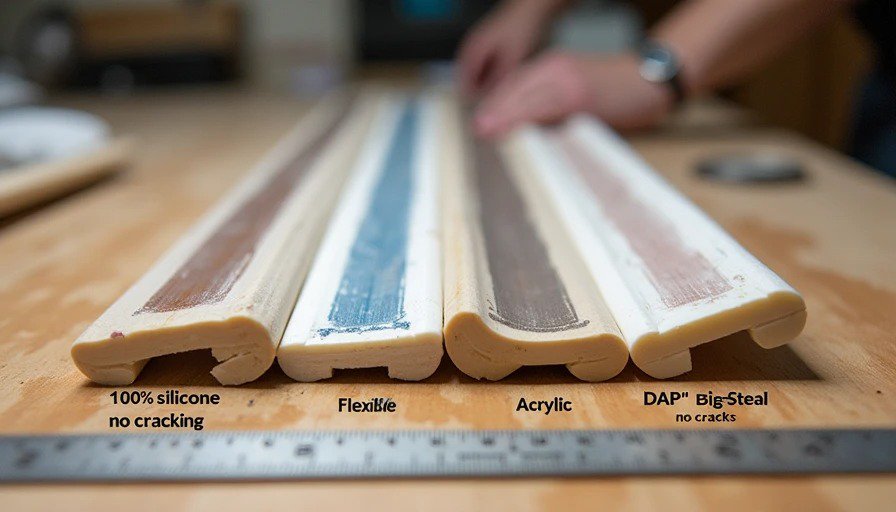
100% silicone (GE and Gorilla) bent around the ½-inch dowel without cracking. I folded them in half — no cracks. I stretched them — they snapped back to original shape.
Sashco Big Stretch (acrylic latex) cracked on the ½-inch dowel. It's called "Big Stretch" — but it's still acrylic. It doesn't have the elastic recovery of silicone.
DAP Kwik Seal Ultra (siliconized acrylic) cracked slightly on the ½-inch dowel but held together better than the Sashco.
Here's the real-world implication:
A shower enclosure expands and contracts with temperature changes. In Portland, that means winter cold and summer heat — plus the thermal shock of hot water hitting cold tile. Over time, the joint moves.
Silicone moves with it. Acrylic doesn't.
Sashco Big Stretch is designed for exterior applications — window frames, door casings, siding. It stretches, but it doesn't rebound like silicone. For a shower that moves daily? It's the wrong tool for the job.
Test 3: UV Resistance — The Sun Test
I placed samples of each caulk on a south-facing windowsill in my workshop. Full sun. 60 days. Portland winter sun (weak) — but enough to see degradation.
After 60 days:
Caulk | UV Degradation | Color Change | Surface Condition |
GE Advanced ($8) | Minimal | Slight yellowing | Smooth, intact |
Gorilla ($10) | Minimal | Slight yellowing | Smooth, intact |
DAP Kwik Seal ($9) | Moderate | Yellowed | Slight cracking |
Sashco Big Stretch ($20) | Severe | Yellowed, chalky | Cracking, degraded |
The 100% silicones (GE and Gorilla) held up. The UV rays didn't break down the molecular structure
The acrylics (DAP and Sashco) degraded. The Sashco developed a chalky surface and visible cracks after 60 days. For an interior shower, UV isn't a concern. For an exterior window or door? It matters.
A 40-year study conducted by Momentive Performance Materials (formerly GE Silicones) found that silicone sealants consistently outperformed polyurethane and acrylic alternatives in durability, elastic recovery, and surface integrity — even after four decades of outdoor exposure
Silicone samples maintained smooth surfaces with minimal cracking or discoloration, while acrylic samples showed severe degradation
That study was on construction-grade sealants, not hardware-store caulk. But the chemistry is the same. Silicone resists UV. Acrylic doesn't.
Test 4: Mold Resistance — The Humidity Chamber
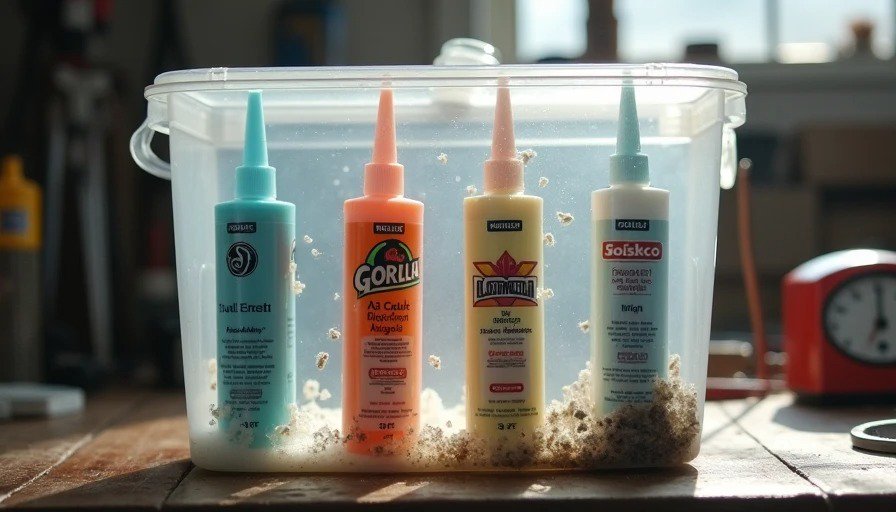
I built a simple humidity chamber in my workshop — a plastic bin with a lid, a pan of water, and a small space heater to keep it at 90°F and 90% humidity. I placed samples of each caulk inside for 60 days.
After 60 days:
Caulk | Mold Growth | Surface Condition |
GE Advanced ($8) | None | Clean |
Gorilla ($10) | None | Clean |
DAP Kwik Seal ($9) | Light spots | Some discoloration |
Sashco Big Stretch ($20) | Moderate growth | Visible mold colonies |
The 100% silicones resisted mold. Both GE and Gorilla came out clean.
DAP Kwik Seal Ultra claims a "lifetime mold and mildew resistance guarantee"-
. In my test, it developed light mold spots after 60 days. Not terrible — but not "lifetime."
Sashco Big Stretch had visible mold colonies. It's not marketed as mold-resistant — and it showed.
Here's the kicker: In a real shower, mold grows on dirt and soap scum, not on the caulk itself. But porous surfaces (like acrylic and latex) trap dirt more easily than non-porous silicone. So silicone stays cleaner, longer.
The Full Scorecard
Test | Weight | GE Advanced ($8) | Gorilla ($10) | DAP Kwik Seal ($9) | Sashco Big Stretch ($20) |
Adhesion | 30% | 9/10 | 8/10 | 6/10 | 4/10 |
Flexibility | 25% | 10/10 | 10/10 | 6/10 | 5/10 |
UV Resistance | 20% | 9/10 | 9/10 | 5/10 | 3/10 |
Mold Resistance | 25% | 10/10 | 10/10 | /10 | 4/10 |
Weighted Score | 100% | 9.5 | 9.2 | 6.1 | 4.0 |
The $8 GE Advanced Silicone wins. By a lot.
So What Should You Buy?
Buy GE Advanced Silicone (~$8) if:
You're sealing a shower, bathtub, or kitchen sink
You want the strongest adhesion to tile and porcelain
You want mold resistance that actually works
You need flexibility that won't crack over time
You don't care about painting over it (you can't)
This is the best all-around silicone caulk for wet areas. It's cheap, it works, and it lasts.
Buy Gorilla Silicone (~$10) if:
GE Advanced Silicone isn't available in your store
You need a slightly tougher formula for exterior applications
You're okay paying $more for a comparable product
Gorilla is a close second. It's good. GE is slightly better on adhesion.
Buy DAP Kwik Seal Ultra (~$9) if:
You need a paintable sealant
You're sealing painted drywall or trim
You're not in a high-moisture area
You want easy cleanup (water-based)
This is a good product for the right application — interior trim, baseboards, crown molding. Just don't use it in a shower.
Skip Sashco Big Stretch (~$20) for showers:
It's not designed for wet areas — it's an exterior sealant
It doesn't bond well to tile or porcelain
It doesn't resist mold
It costs more than twice as much as the GE
Sashco Big Stretch is a great product — for exterior window and door casings, where extreme movement is the main concern. For a shower? It's the wrong tool for the job.
The Real Question: Why Does the $20 Caulk Cost More?
Because it's not designed for what you're using it for.
Sashco Big Stretch is formulated for exterior joints that experience extreme thermal movement — window frames, siding, door casings. It's designed to stretch up to inches without cracking.
That requires a different chemistry — more elastomeric polymers, less silicone.
That chemistry costs more to manufacture. But it also performs worse in wet, indoor environments.
You're paying $20 for a sealant that's optimized for a different job.
The $8 GE Advanced Silicone is optimized for exactly what you need — waterproofing, adhesion to tile, mold resistance, and flexibility for indoor thermal movement.
The 40-Year Context
Here's something that blew my mind:
In 1983, GE Silicones (now Momentive Performance Materials) launched one of the world's most ambitious sealant weathering studies
They applied 13 different sealant chemistries to test panels and left them exposed to Florida's tropical climate — intense UV, high humidity, salt air, and tropical storms
The study is still running. It's now in its fifth decade
The results? Silicone sealants consistently outperformed polyurethane and acrylic alternatives in durability, elastic recovery, and surface integrity
After 40 years of outdoor exposure, most silicone samples showed 100% elastic recovery after a 180° bend.Polyurethane and acrylic samples stiffened significantly or broke down under stress.
That's 40 years. In Florida sun. No maintenance.
Your shower gets nowhere near that level of abuse. But the chemistry is the same. Silicone lasts.
My Personal Choice
For my own house? The 195Portland ranch.
I use GE Advanced Silicone in every shower, every tub, and every kitchen sink I seal. It's $8. It works. It lasts.
I use Sashco Big Stretch on exterior window casings and door frames, where the wood moves with the seasons. It's $20. It stretches. It doesn't crack.
Match the material to the application. That's the whole point of this blog.
The Fine Print
I bought all test materials myself. No brand sent me free samples. No one paid me for this post.
These are the results from one batch, one batch lot from each manufacturer. Your experience may vary with different batches, different colors, or different application methods.
All tests were conducted in a garage workshop in Portland, Oregon, in winter 2025-2026. YMMV.
The 40-year study results are from Momentive Performance Materials' publicly available research. I'm citing it because it's the most comprehensive long-term sealant data available.
No signals yet — transmit the first.