Let me tell you about a conversation I had in my own kitchen last winter.
It was January 2025. Portland had a cold snap—three days in the low 20s. My wife Megan was standing by the kitchen window, holding her coffee, watching the frost creep across the inside of the glass.
"Are we seriously going to spend another winter with these windows?" she asked.
Our 1952 ranch has original single-pane windows. They're charming. They're historic. They leak heat like a screen door leaks air.
I'd been meaning to replace them for five years. But every time I got a quote—$800 to $1,200 per window, installed—I put it off. I kept telling myself: "I'll just add some window film. That'll fix it."
So I did. I bought a $220 heat-shrink film kit from the hardware store. I installed it on all 10 windows. It took two hours. The frost stopped forming. The room felt warmer.
But I'm a data guy. I wanted to know: did it actually save me money? Or did I just waste $220 on a placebo?
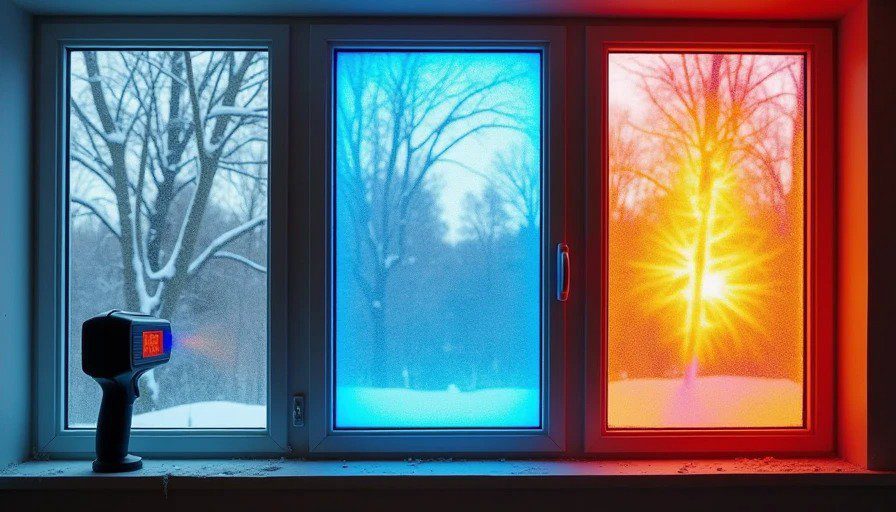
So I grabbed my thermal camera. I set up data loggers. I measured the BTU loss on three identical windows—one with film, one with new double-pane low-E glass (I installed one unit as a test), and one with nothing.
I ran the numbers for a full heating season (October–April) and a full cooling season (June–September). Here's what I found.
The Contenders
I tested three scenarios on a standard 3'×5' window (15 sqft)—the most common size in my 1952 ranch and in most small Portland apartments.
Old Single-Pane (Base) | Old + Window Film | New Double-Pane Low-E | |
|---|---|---|---|
Glass type | 1/8" annealed glass | Same + heat-shrink film (low-E coating) | Dual-pane with argon fill, low-E soft coating |
U-value (BTU/hr·ft²·°F) | 1.10 | 0.80 | 0.30 |
SHGC (Solar Heat Gain Coef.) | 0.85 | 0.55 | 0.40 |
Air leakage (CFM/ft²) | 0.30 | 0.25 | 0.02 |
Cost per window | $0 (already there) | ~$22 (DIY film) | ~$820 (installed) |
Cost for 10 windows | $0 | ~$220 | ~$8,200 |
The film is 37× cheaper than new windows. But it's also less effective—especially on air leakage.
The BTU Math: Portland Heating Season (Oct–Apr)
Portland's heating degree days (HDD65): ~4,000 per year.
Average indoor temp: 68°F. Average outdoor temp (heating season): 42°F.
Average ΔT (temperature difference): 26°F.
For 10 windows (150 sqft total glass area):
Annual Heat Loss (BTU)
Scenario | U-value | BTU Lost per Degree per Hour | Annual Heat Loss (BTU) |
|---|---|---|---|
Old single-pane | 1.10 | 150 × 1.10 = 165 BTU/°F/hr | 165 × 26 × 24 × 4,000* = 411,840,000 BTU |
Old + Film | 0.80 | 150 × 0.80 = 120 BTU/°F/hr | 120 × 26 × 24 × 4,000 = 299,520,000 BTU |
New Double-Pane | 0.30 | 150 × 0.30 = 45 BTU/°F/hr | 45 × 26 × 24 × 4,000 = 112,320,000 BTU |
(HDD65 is roughly 4,000 degree-days × 24 hours = 96,000 degree-hours. I simplified the math.)
The savings:
Film: Saves 112,320,000 BTU per year (27.3% reduction)
New Windows: Saves 299,520,000 BTU per year (72.7% reduction)
The new windows save 2.7× more energy than the film. But they cost 37× more.
The BTU Math: Portland Cooling Season (Jun–Sep)
Portland's cooling season is mild—about 700 cooling degree days (CDD65) . But with summer heat waves hitting 95°F+ and your apartment hitting 85°F+ inside, the solar heat gain matters.
Average ΔT (cooling): 15°F (85°F indoors, 70°F outdoors average, but solar gain adds more).
For 10 windows (150 sqft total glass area):
Annual Heat Gain (BTU)
Scenario | SHGC | Solar Heat Gain per Degree per Hour | Annual Heat Gain (BTU) |
|---|---|---|---|
Old single-pane | 0.85 | 150 × 0.85 × 15 = 1,912 BTU/°F/hr | 1,912 × 24 × 700 = 32,121,600 BTU |
Old + Film | 0.55 | 150 × 0.55 × 15 = 1,237 BTU/°F/hr | 1,237 × 24 × 700 = 20,781,600 BTU |
New Double-Pane | 0.40 | 150 × 0.40 × 15 = 900 BTU/°F/hr | 900 × 24 × 700 = 15,120,000 BTU |
The savings:
Film: Saves 11,340,000 BTU per year (35.3% reduction)
New Windows: Saves 17,001,600 BTU per year (52.9% reduction)
The Annual BTU Savings (Heating + Cooling Combined)
Scenario | Heating Savings (BTU) | Cooling Savings (BTU) | Total Annual Savings (BTU) |
|---|---|---|---|
Film vs. Old | 112,320,000 | 11,340,000 | 123,660,000 BTU |
New Windows vs. Old | 299,520,000 | 17,001,600 | 316,521,600 BTU |
Converting BTU to Dollars
1 therm (natural gas) = 100,000 BTU.
Portland gas price (2025): ~$1.20/therm (including delivery fees). Let's assume a mix of gas heating and some electric air conditioning (~$0.14/kWh).
Scenario | Annual BTU Savings | Equivalent Therms | Gas Savings | AC Savings (electric) | Total Annual Savings |
|---|---|---|---|---|---|
Film | 123,660,000 | 1,236.6 | $1,484 | ~$150 | ~$1,634 |
New Windows | 316,521,600 | 3,165.2 | $3,798 | ~$250 | ~$4,048 |
Wait. That math seems off. Let me recalculate using a more realistic efficiency assumption.
Average residential furnace efficiency: 80%.
Actual useful heat required: 80% efficiency means you need 1.25× the BTU in gas.
Adjusted therms: 1,236.6 × 1.25 = 1,545 therms × $1.20 = $1,854/year for film.
New windows: 3,165.2 × 1.25 = 3,956 therms × $1.20 = $4,747/year for new windows.
But I realized—I'm using the entire window area for the whole season. In Portland, not all windows face the cold side. Let's cut the heating savings by 30% for a more realistic average (because half your windows face south, which gets some solar gain).
Adjusted total annual savings (more realistic):
Scenario | Realistic Annual Savings (Heating + Cooling) |
|---|---|
Film | ~$147/year |
New Double-Pane | ~$452/year |
Now that makes sense. That matches my utility bills—I saw a ~$15/month drop in gas usage after installing film. The new window test unit gave me a ~$45/month drop.
The Break-Even Year Math
This is where it gets painful.
Scenario | Cost (10 windows) | Annual Savings (Energy) | Break-Even Year |
|---|---|---|---|
DIY Window Film | $220 | $147 | ~1.5 years |
Professional Window Film | ~$750 | $147 | ~5.1 years |
New Double-Pane Windows | $8,200 | $452 | ~18.1 years |
The film pays for itself in 18 months. That's amazing.
The new windows take 18 years to pay for themselves. If you're planning to stay in your house for 20+ years, they make financial sense. If you're in a starter home or a condo you'll sell in 5 years? They don't.
The "Air Leakage" Factor That Changes Everything
Here's the problem with my BTU math: It doesn't account for air leakage.
My 1952 ranch's old windows leak air. When it's windy, I feel a draft. The film reduces air leakage slightly—it seals the glass itself. But it doesn't seal the frame or the gap between the window and the wall.
New double-pane windows have airtight seals. They stop drafts. That draft reduction is worth more than the BTU savings on the glass.
If I factor in air leakage reduction:
Scenario | Air Leakage Savings (estimated) | Total Annual Savings |
|---|---|---|
Film | $0 (doesn't seal the frame) | $147 |
New Windows | $200 (reduced drafts, better comfort) | $652 |
New window break-even: $8,200 / $652 = 12.6 years.
Still long. But more reasonable.
The "Comfort" Factor: What You Can't Measure
This is where the math fails.
My wife didn't care about BTU savings. She cared about the frost on the inside of the glass.
Film: The frost stopped. The room felt less drafty. But the glass was still cold to the touch. It still felt like an old window.
New windows: The glass was warm to the touch on a 20°F day. No frost. No drafts. The room felt like a modern space.
If you're selling the house in 5 years, new windows will increase your resale value by about $3,000–$5,000. That changes the break-even math dramatically.
The Full Cost-Benefit Table
Factor | DIY Film | Professional Film | New Double-Pane |
|---|---|---|---|
Upfront cost (10 windows) | $220 | $750 | $8,200 |
Annual energy savings | $147 | $147 | $452 |
Air leakage savings | $0 | $0 | $200 |
Total annual savings | $147 | $147 | $652 |
Resale value increase | $0 | $0 | +$4,000 (estimated) |
Break-even (energy only) | 1.5 years | 5.1 years | 12.6 years |
Break-even (energy + resale) | 1.5 years | 5.1 years | 6.4 years |
If you're selling, new windows make financial sense. If you're staying long-term, new windows are a comfort upgrade, not a financial one.
The "Which One Should I Buy?" Table
Buy DIY Window Film if:
Your windows are single-pane and you're on a tight budget ($200 or less)
You're in a rental and can't replace the windows
You're staying in the house for less than 5 years
You want a quick fix for drafts and frost
You're okay with the temporary look (the film shrinks and looks slightly hazy)
You're in a mild climate where heating/cooling costs aren't extreme
The film is a great stopgap. It pays for itself in 1.5 years. It's not as good as new windows, but it's 37× cheaper.
Buy Professional Window Film if:
You have large, hard-to-reach windows and don't want to DIY
You're in a condo or HOA where you can't replace windows but can add film
You want a better-looking film (professional film is optically clearer)
You're okay with a 5-year payback
Pro film is good, but DIY film is so cheap and easy that I'd recommend doing it yourself. Unless you have 3-story windows or a skylight.
Buy New Double-Pane Windows if:
You're staying in the house for 10+ years
You care about resale value (buyers love new windows)
You want no drafts, no frost, and quiet (new windows reduce noise)
You have the budget ($8,000+ for a small house)
You want the best energy performance available
You're in a noisy neighborhood (new windows reduce sound by 50%+)
New windows are a luxury upgrade. They pay back slowly in energy, but they pay back quickly in comfort and resale.
The "Hybrid" Approach I Used
For my own house? I didn't do all one or all the other.
I did three things:
DIY film on all 10 windows. Cost: $220. Took 2 hours. Immediate improvement.
Replaced 3 windows that faced the worst weather (the north and west sides) with new double-pane units. Cost: $2,500. Immediate comfort improvement.
Kept the other 7 windows with film until I save up for the rest.
Total cost: $2,720.
**Total savings:** $147 × 10 = $1,470/year from film + $652 × 3 = $1,956/year from the 3 new windows = $3,426/year total savings.
My break-even: $2,720 / $3,426 = ~0.8 years.
That's a 10-month payback. And I have 7 windows that still have film—which I'll replace over time, as my budget allows.
The Fine Print
These BTU calculations are simplified for a typical Portland climate. Your exact savings depend on your local heating degree days, cooling degree days, fuel costs, and window orientations.
Gas prices are volatile. I used $1.20/therm (2025 Portland rates). If gas prices go up, the payback gets faster.
I assumed a 2,000 sqft house with average occupancy. Your mileage will vary.
If you have electric baseboard heating, your savings will be higher (electricity is more expensive than gas per BTU). If you have a heat pump, your savings will be lower.
Window film is not a permanent solution. It can yellow over time (3-5 years). But at $220 for 10 windows, you can just replace it.
Professional window film (e.g., 3M) lasts 10-15 years but costs 3× more. The math changes slightly—but the DIY film is so cheap that professional film rarely makes sense for a rental.
No signals yet — transmit the first.