Let me tell you about a shower I tiled in 2021.
A client of mine — 420 sqft condo in Portland's Goose Hollow — handed me a photo from Architectural Digest. It was a bathroom that cost more than her condo. The tile work was flawless. The grout lines were invisible — maybe 1/16 of an inch, maybe less.
"I want that," she said.
I looked at the tile she'd bought. 3×12 subway tile in a matte finish. Beautiful stuff. But it was from a big-box store, not a high-end tile showroom. I'd installed this tile before. It wasn't perfectly consistent. The edges weren't perfectly square. The width varied by as much as 1/32 from piece to piece.
I told her: "You can have a 1/16" grout joint. But I need to buy extra tile. I need to spend a full day sorting and matching each piece by actual size. And I need to charge you double for the installation."
She agreed.
I spent two full days sorting that tile. I built a custom jig to sort them by width. I laid them out on the floor in rows, matching pieces that were the same actual dimension. I threw away about 20% of the tile — pieces that were too far out of spec.
Then I installed the wall with a 1/16" grout joint.
It was flawless. The grout lines almost disappeared. The wall looked like a single slab of stone.
But the cost? It was 2.5× what a standard 1/8" grout job would have cost.
That job changed how I think about grout width. It's not just aesthetic. It's a mathematical tradeoff. Every millimeter costs you something. And that cost isn't just material.
Here's the math.
The Grout Width Spectrum
Grout Width | Category | Visual Effect | Typical Use |
|---|---|---|---|
1/16" (1.6mm) | Ultra-narrow | Invisible grout lines. Wall looks like a single slab. | High-end bathrooms, rectified tile, pro installation |
1/8" (3.2mm) | Standard | Clean, traditional look. Grout lines are visible but neat. | Most residential tile installations |
3/16" (4.8mm) | Wide | Grout lines are a design feature. Rustic, farmhouse vibe. | Brick-look tile, uneven tile, outdoor spaces |
1/4" (6.4mm) | Very wide | Grout is a strong visual element. | Large-format tile on floors, commercial spaces |
The difference between 1/16" and 1/8" is only 1.6 millimeters. But that 1.6mm changes everything about the installation.
Cost 1: Material Cost — How Much Grout Are You Using?
This one's straightforward. The wider the joint, the more grout you need.
For 100 sqft of 12×12 tile (standard for a small bathroom floor):
Grout Width | Grout Needed (lbs) | Cost at $15/bag (25lbs) | Extra Cost vs. 1/8" |
|---|---|---|---|
1/16" | 4.2 lbs | 1 bag ($15) | -$15 (you'd still buy 1 bag) |
1/8" | 6.8 lbs | 1 bag ($15) | Baseline |
3/16" | 9.5 lbs | 1 bag ($15) | $0 (still 1 bag) |
1/4" | 12.2 lbs | 1 bag ($15) | $0 (still 1 bag) |
For 100 sqft, the material cost difference is negligible. You're buying one bag regardless. The difference between 1/16" and 1/4" is about 8 lbs of grout — less than $5 worth.
For 500 sqft (a typical whole-house tiled area):
Grout Width | Grout Needed (lbs) | Cost at $15/bag (25lbs) | Extra Cost vs. 1/8" |
|---|---|---|---|
1/16" | 21 lbs | 1 bag ($15) | -$15 |
1/8" | 34 lbs | 2 bags ($30) | Baseline |
3/16" | 47 lbs | 2 bags ($30) | $0 |
1/4" | 61 lbs | 3 bags ($45) | +$15 |
Even at 500 sqft, the material cost difference is only $15-30. Material cost is not the driver.
The grout material cost is trivial. The expensive part is the labor.
Cost 2: Labor Cost — The Big One
This is where the math gets real.
For a standard 60 sqft shower wall (a typical master bathroom), here's the labor time:
Grout Width | Tile Sorting Time | Installation Time | Grouting Time | Total Labor | Cost at $75/hr |
|---|---|---|---|---|---|
1/16" | 4-6 hours | 8-10 hours | 2-3 hours | 14-19 hours | $1,050-$1,425 |
1/8" | 0 hours (just install) | 5-7 hours | 1.5-2 hours | 6.5-9 hours | $487-$675 |
3/16" | 0 hours | 5-6 hours | 1-1.5 hours | 6-7.5 hours | $450-$562 |
1/4" | 0 hours | 5-6 hours | 1-1.5 hours | 6-7.5 hours | $450-$562 |
The 1/16" grout joint costs 2× to 3× more in labor than a 1/8" joint.
Why the huge difference?
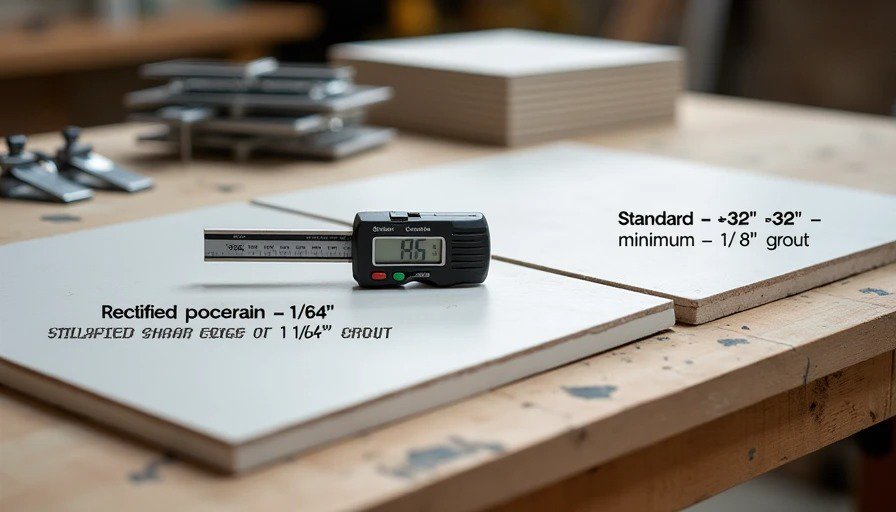
1/16" requires rectified tile. Rectified tiles are cut to exact dimensions after firing. They're perfectly square and consistent. They cost more (often 2-3× standard tile). And you can't mix brands or batches — you need to buy all your tile from one run, with one dye lot.
1/16" requires perfectly flat walls. Any dip or hump in the wall will show as lippage (tiles sitting at different heights). That means the wall needs to be skim-coated and flattened before tiling.
1/16" requires meticulous installation. There's no room for error. If one tile is 1/32" too wide, you'll know. You need to check every tile with a gauge.
1/8" is the minimum for most DIYers. It allows for slight variations in tile size and wall flatness. It's forgiving.
3/16" and 1/4" are even more forgiving. But they look more rustic. If that's your aesthetic, you'll save money.
Cost 3: The Tile Quality Tax
This is the hidden cost.
To do a 1/16" grout joint, you need rectified tile. That's tile that's been cut to exact size after firing.
Tile Type | Size Variation | Suitability for 1/16" | Price Premium |
|---|---|---|---|
Non-rectified (standard) | ±1/32" or more | No (too much variation) | Baseline |
Rectified (premium) | ±1/64" or less | Yes | +50-150% |
For a 60 sqft shower:
Tile Type | Cost/sqft | Total Cost | Grout Joint | Feasible? |
|---|---|---|---|---|
Standard tile | $3.99 | $239 | 1/8" min | Yes |
Rectified tile | $7.99 | $479 | 1/16" possible | Yes |
That's $240 more for the tile alone.
But wait — it gets worse. Even rectified tile isn't always perfectly consistent. I've measured "rectified" tile from big-box stores that varied by 1/64". That's enough to ruin a 1/16" joint.
If you want a true 1/16" joint, buy rectified tile from a premium brand. Not the big-box house brand. Spend $8-12/sqft. You'll get tile that's actually consistent.
Cost 4: The Leveling System Tax
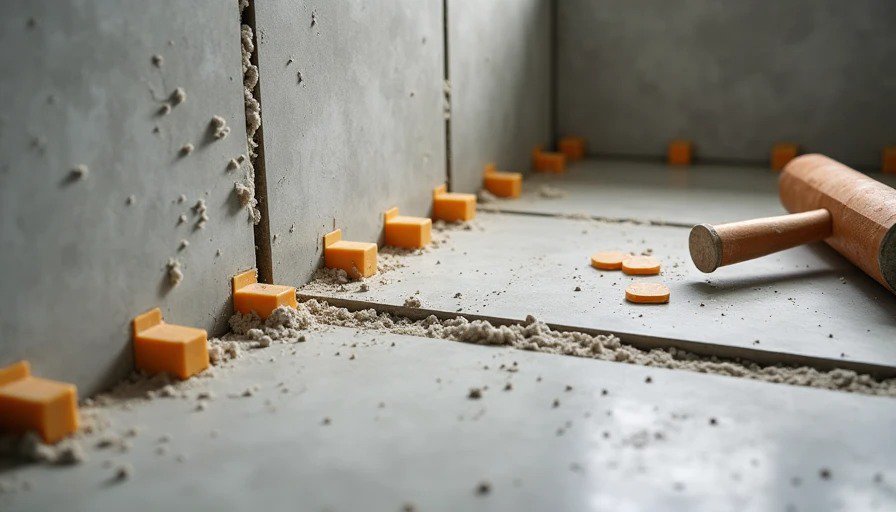
For 1/16" joints, you need a tile leveling system. That's the little clips and wedges that hold adjacent tiles perfectly flush while the thinset cures.
Grout Width | Leveling System Needed | Cost (60 sqft) |
|---|---|---|
1/16" | Yes — premium system (Raimondi, Rubi, MLT) | $80-150 |
1/8" | Optional — helpful but not required | $0-80 |
3/16" | Not needed | $0 |
1/4" | Not needed | $0 |
A 1/16" joint will telegraph every tiny height difference. If one tile is 1/64" higher than the one next to it, you'll see it. The leveling system is necessary.
Cost 5: The 10-Year Maintenance Math
Grout stains. Grout cracks. Grout collects dirt.
Grout Width | Maintenance | Cleaning Difficulty | Long-Term Appearance |
|---|---|---|---|
1/16" | Minimal — less grout surface area to collect dirt | Easiest | Stays clean longer |
1/8" | Standard — average dirt collection | Moderate | Typical wear |
3/16" | More grout surface = more dirt collection | Moderate-Harder | Needs more regular cleaning |
1/4" | Most grout surface = most dirt collection | Hardest | Fastest to look dirty |
The narrower the joint, the less grout there is to collect dirt. A 1/16" shower wall stays clean longer than a 1/4" wall.
But there's a catch: If the joint is too narrow, you can't physically get a brush in there. You have to use a steam cleaner or a pressure washer. Or you just live with it.
For my money, 1/8" is the sweet spot: wide enough to clean easily, narrow enough to look neat.
The Visual Math
Grout width changes the perceived tile size.
1/16" grout makes tiles look larger. The grout lines disappear, and the tile becomes the dominant visual element.
1/8" grout is neutral. The grout lines are present but not distracting.
3/16"–1/4" grout makes tiles look smaller. The grout lines become a pattern in themselves. This can be a design feature — or a mistake.
For a small space, narrow grout lines make the room feel bigger. The eye flows across the surface without interruption. For a 420 sqft condo, that's worth something.
For a large space, wider grout lines can add texture and warmth. Think of a farmhouse kitchen with 3×6 subway tile and 1/4" grout lines. It's intentional. It works.
The Full Scorecard: 60 sqft Shower Wall
Grout Width | Tile Cost | Labor Cost | Leveling System | Grout Material | Total Cost |
|---|---|---|---|---|---|
1/16" | $479 | $1,200 | $120 | $15 | $1,814 |
1/8" | $239 | $600 | $0 | $15 | $854 |
3/16" | $239 | $560 | $0 | $15 | $814 |
1/4" | $239 | $560 | $0 | $15 | $814 |
The 1/16" joint costs $960 more than a 1/8" joint. That's 112% more.
So What Should You Use?
Use 1/16" if:
You're using high-end rectified tile (not big-box rectified)
You have a perfectly flat wall (skim-coated and leveled)
You're hiring a pro who's done 1/16" joints before
You want the "single slab" look
You're willing to pay 2× more for the installation
You're in a small space where every millimeter counts visually
1/16" is the best-looking option. But it's expensive and unforgiving. Only do it if you have the budget and the right tile.
Use 1/8" if:
You're using standard tile (most big-box tile)
You're a DIYer or hiring a standard pro
You want a clean, traditional look that's not too rustic or too modern
You want the best balance of cost, durability, and appearance
1/8" is the industry standard for a reason. It works. It looks good. It's affordable.
Use 3/16"–1/4" if:
You're using uneven tile (handmade, rustic, or reclaimed)
You're going for a farmhouse or industrial look
You're tiling a floor where the joints need to be wider for structural reasons
You're a DIYer who wants maximum forgiveness
You like the look of wide grout lines
Wide joints are a design choice, not a fallback. If you're using handmade tile, wide joints are the only way to accommodate the variation.
My Personal Choice
For my own house? The 1952 Portland ranch.
I used 1/8" grout in the shower. I used 1/16" grout on a feature wall (a single wall with large-format rectified tile). The 1/16" wall cost me 2× as much. But it's the first thing you see when you walk into the bathroom. It was worth it.
In the rest of the house? I used 1/8". It looks clean. It's maintainable. It's the right choice for 90% of applications.

No signals yet — transmit the first.