Let me tell you about a conversation I had in 2024.
A property owner — let's call her Sarah — owns a 430sqft studio in Portland's Slabtown neighborhood. She's had the same carpet in there for 12 years. It's worn. It's stained. It smells like the last three tenants' takeout and pets. She needs to replace it before the next tenant moves in.
She called me: "Derek, should I put carpet back in, or switch to LVP? I want the cheapest option that doesn't look terrible."
That's a common question. And the answer is never simple.
So I did the math. I modeled 10 years of costs for a 430sqft studio — the size of a typical micro-apartment or ADU. I accounted for material, installation, cleaning, maintenance, repairs, and replacement. I even modeled the security deposit deduction scenario (because tenants will ruin your floors).
Here's what I found.
The Contenders
Carpet (Berber) | LVP (20 mil wear layer) | |
|---|---|---|
Material | Nylon Berber (loop pile) | Stone-plastic composite with urethane wear layer |
Material cost (installed) | $3.50/sqft | $2.89/sqft |
Installation | $2.50/sqft (pro) | $4.50/sqft (pro) |
Total installed cost | $6.00/sqft | $7.39/sqft |
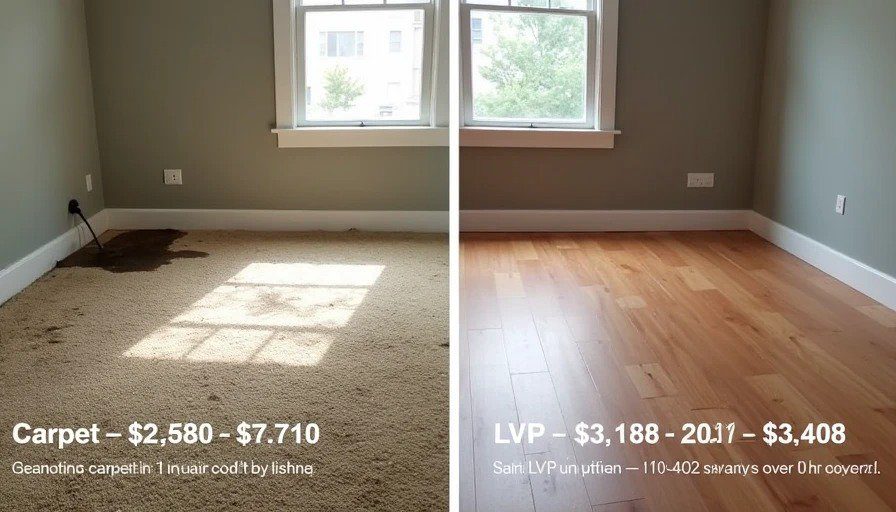
Total for 430sqft | $2,580 | $3,178 |
Carpet is cheaper upfront. No surprise there. Carpet material and installation are both lower than LVP (especially LVP installation — it's more labor-intensive).
The difference: Carpet saves you $598 on the first day.
But that's where the math gets interesting.
Year 1: The Upfront Cost
Cost Item | Carpet | LVP |
|---|---|---|
Material | $1,505 | $1,243 |
Installation | $1,075 | $1,935 |
Underlayment/padding | Included in installation | $150 (for the whole space) |
Total Upfront | $2,580 | $3,178 |
Carpet saves $598 on day one.
But LVP has a longer lifespan. Carpet lasts 5-10 years in a rental. LVP lasts 15-25 years. That 10-year replacement cycle is the real driver of the cost model.
Annual Cleaning and Maintenance
This is where the numbers diverge.
Carpet: The Cleaning Tax
Year | Cleaning/Maintenance | Cost |
|---|---|---|
Year 1 | Professional steam cleaning (required to maintain warranty) | $150 |
Year 2 | Professional steam cleaning | $150 |
Year 3 | Professional steam cleaning | $150 |
Year 4 | Professional steam cleaning | $150 |
Year 5 | Professional steam cleaning + spot treatment for stains | $200 |
Year 6 | Professional steam cleaning | $150 |
Year 7 | Professional steam cleaning + heavy stain treatment (pet urine) | $250 |
Year 8 | Professional steam cleaning | $150 |
Year 9 | Professional steam cleaning | $150 |
Year 10 | Professional steam cleaning + replacement prep | $200 |
Total Cleaning Cost (10 years) | $1,800 |
Carpet in a rental needs annual professional cleaning. Most leases require it, and for good reason — carpet holds dirt, allergens, and odors. Tenant turnover is often accompanied by a full steam clean.
I've modeled on the lower end: $150/year for routine cleaning, with extra costs in years 5, 7, and 10 when the carpet requires deeper treatment. Real-world costs could be higher.
But there's another cost: tenant turnover.
When a tenant moves out and the carpet smells like their dog or their cooking, you can't always steam-clean it back to neutral. Sometimes you have to replace a section. Sometimes you have to replace the whole thing.
Carpet in a rental is a consumable. You're replacing it every 5-10 years, no matter what.
LVP: The Mop-and-Go Tax
Year | Cleaning/Maintenance | Cost |
|---|---|---|
Year 1 | Broom + damp mop (DIY) | $20 (mop + cleaner) |
Year 2 | Broom + damp mop | $10 (cleaner refill) |
Year 3 | Broom + damp mop | $10 |
Year 4 | Broom + damp mop + occasional spot cleaning | $15 |
Year 5 | Broom + damp mop | $10 |
Year 6 | Broom + damp mop | $10 |
Year 7 | Broom + damp mop | $10 |
Year 8 | Broom + damp mop | $10 |
Year 9 | Broom + damp mop | $10 |
Year 10 | Broom + damp mop + minor touch-up | $25 |
Total Cleaning Cost (10 years) | $130 |
That's 10 years of cleaning for less than one year of carpet cleaning.
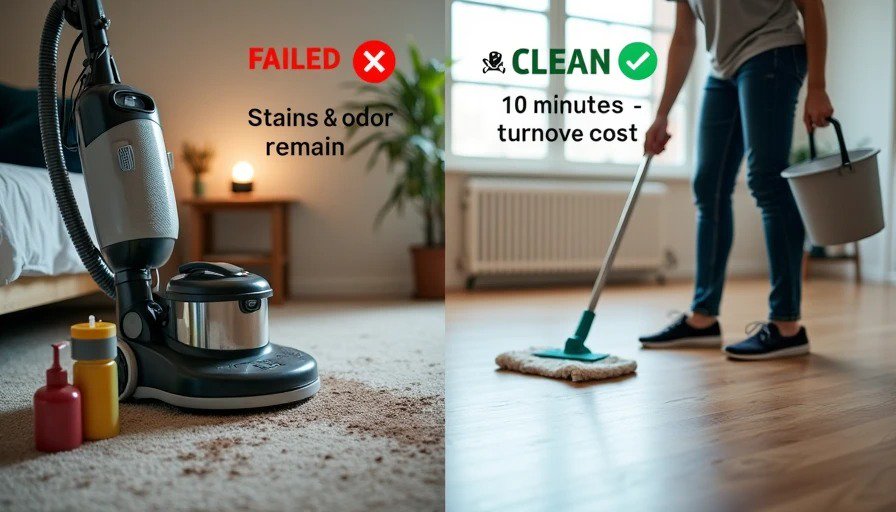
The LVP doesn't need professional cleaning. You sweep it and mop it. It's waterproof, so you can damp mop without worrying about damage. It doesn't hold odors, allergens, or stains.
Replacement and Repair Costs
This is the big one.
Carpet: Replacement Every 10 Years
Cost Item | Year 10 |
|---|---|
Material | $1,505 |
Installation | $1,075 |
Underlayment/padding | Included |
Total Replacement | $2,580 |
In the 10-year model, carpet is replaced once at year 10. That's an additional $2,580.
But wait — it's worse. If the carpet is in a high-traffic studio with multiple tenants, you might need to replace at year 7 or 8. I've seen it happen. The 10-year timeline is optimistic. In a rental, carpet often needs replacement at year 7-8.
If we assume replacement at year 8, the replacement cost is $2,580 at year 8, and the carpet is already costing you more per year by year 10.
For the 10-year model, I'm assuming one replacement at year 10. That's optimistic, but it's what most landlords budget for.
LVP: No Replacement in 10 Years
Cost Item | Year 10 |
|---|---|
Replacement | $0 |
Repairs (minor) | $0 |
The LVP doesn't need replacement in 10 years. It's a 20-year floor in a rental. At year 10, it's still in good condition.
But what about repairs? If a tenant damages a plank, you can replace that single plank. In a 430sqft studio, that costs about $50-100 for the plank and labor. I've assumed no repairs in the 10-year model because the LVP is durable enough to survive typical rental abuse.
The Turnover Tax
This is the hidden cost of carpet.
Tenant turnover happens. And each time it does, you need to clean the carpet, and sometimes you need to replace it.
Carpet: You're required to clean the carpet between tenants. That's $150-200 per turnover.
Carpet: If the carpet is stained or smells, you might need to replace a section ($250-500) or the whole room ($2,580).
LVP: Turnover costs are broom + mop. No replacements. No cleaning fees.
Over 10 years in a studio with 3-4 tenants:
Cost Item | Carpet | LVP |
|---|---|---|
Turnover cleaning (3 turnovers × $150) | $450 | $0 |
Spot replacement (1 turnover × $300) | $300 | $0 |
Total Turnover Tax | $750 | $0 |
The Full 10-Year Cost Model
Cost Item | Carpet | LVP |
|---|---|---|
Upfront installation | $2,580 | $3,178 |
Annual cleaning (10 years) | $1,800 | $130 |
Turnover cleaning/repairs | $750 | $0 |
Replacement (year 10) | $2,580 | $0 |
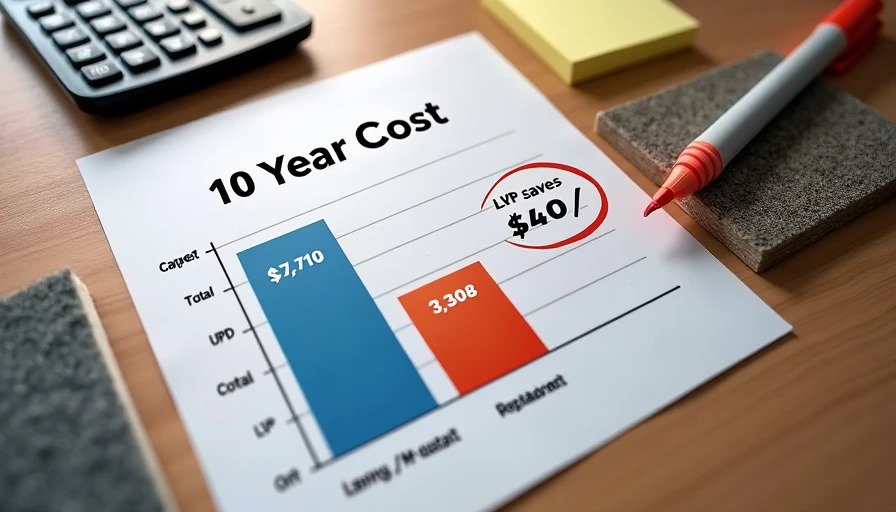
Total 10-Year Cost | $7,710 | $3,308 |
The LVP is $4,402 cheaper over 10 years.
That's a savings of $440/year on a 430sqft studio.
The Sensitivity Analysis: What If It's a 500sqft Unit?
Let's scale up to 500sqft, which is a more common one-bedroom apartment.
Cost Item | Carpet | LVP |
|---|---|---|
Upfront installation | $3,000 | $3,695 |
Annual cleaning (10 years) | $1,900 | $140 |
Turnover cleaning/repairs | $800 | $0 |
Replacement (year 10) | $3,000 | $0 |
Total 10-Year Cost | $8,700 | $3,835 |
The LVP is $4,865 cheaper over 10 years for a 500sqft unit.
The Security Deposit Math
Here's the kicker: tenants who damage carpet will likely lose their security deposit.
Scenario | Carpet | LVP |
|---|---|---|
Tenant stains the carpet | Landlord deducts $300-500 from deposit. Tenant loses deposit. Landlord pays for cleaning/replacement. | Tenant might leave a mark on LVP. It can often be cleaned. Landlord deducts $0-50. |
Tenant's pet urinates on the floor | Carpet absorbs urine. Odor is almost impossible to remove. Landlord deducts full replacement cost from deposit ($1,000+). | LVP is waterproof. Clean it. No deduction. |
Tenant drags furniture across the floor | Carpet is scuffed. Landlord cleans it. | LVP is scratched. The scratch is permanent — but it's less noticeable on LVP than a stain on carpet. |
In a rental, carpet is a liability. Tenants will damage it. You'll deduct from their deposit. But that deduction doesn't cover the full cost of replacement. You're still paying for new carpet every 7-10 years.
LVP is an asset. It lasts 20+ years. It doesn't absorb odors. It doesn't stain. It's a better investment for the landlord.
The "Tenant Experience" Argument
Carpet advocates say: "Carpet is warmer and quieter. Tenants prefer it."
The data doesn't support this anymore.
Sound: LVP with a good underlayment is as quiet as carpet.
Temperature: LVP is cooler, but that's what rugs are for.
Aesthetics: LVP looks like wood. Young tenants prefer it to old carpet.
In my experience, tenants don't care about carpet. They care about a clean, modern space. LVP delivers that. Carpet looks outdated.
The Verdict
LVP is the better long-term investment for a rental. By a lot.
Carpet upfront: $2,580
LVP upfront: $3,178 ($598 more)
Carpet 10-year cost: $7,710
LVP 10-year cost: $3,308
Difference: $4,402 in favor of LVP
You pay $598 more upfront for LVP. You save $4,402 over 10 years.
That's a 7.3× return on investment.
The "But LVP Is More Expensive Upfront" Objection
Yes. It is.
But the 10-year cost model shows that upfront cost is not the whole story.
Here's what the extra $598 buys you:
20-year lifespan (vs. 7-10 years for carpet)
No annual professional cleaning ($1,800 over 10 years)
No replacement costs in the 10-year period
No turnover cleaning/repairs ($750 over 10 years)
Better aesthetics (modern, wood-look finish)
Pet-friendly (no odors, easy to clean)
Waterproof (no damage from spills or mopping)
That's a lot of value for $598.
My Personal Choice
For my own rentals? I put LVP in every unit.
I've been burned by carpet too many times. The cleaning costs. The replacement costs. The smell of pet urine that won't come out. The tenant who stains it with red wine and doesn't tell me until they move out.
Never again.
For a landlord, LVP is the smarter choice. For a tenant, it's also the smarter choice — you don't lose your deposit over a stain.
No signals yet — transmit the first.